
See every luminaire, not just the circuit.
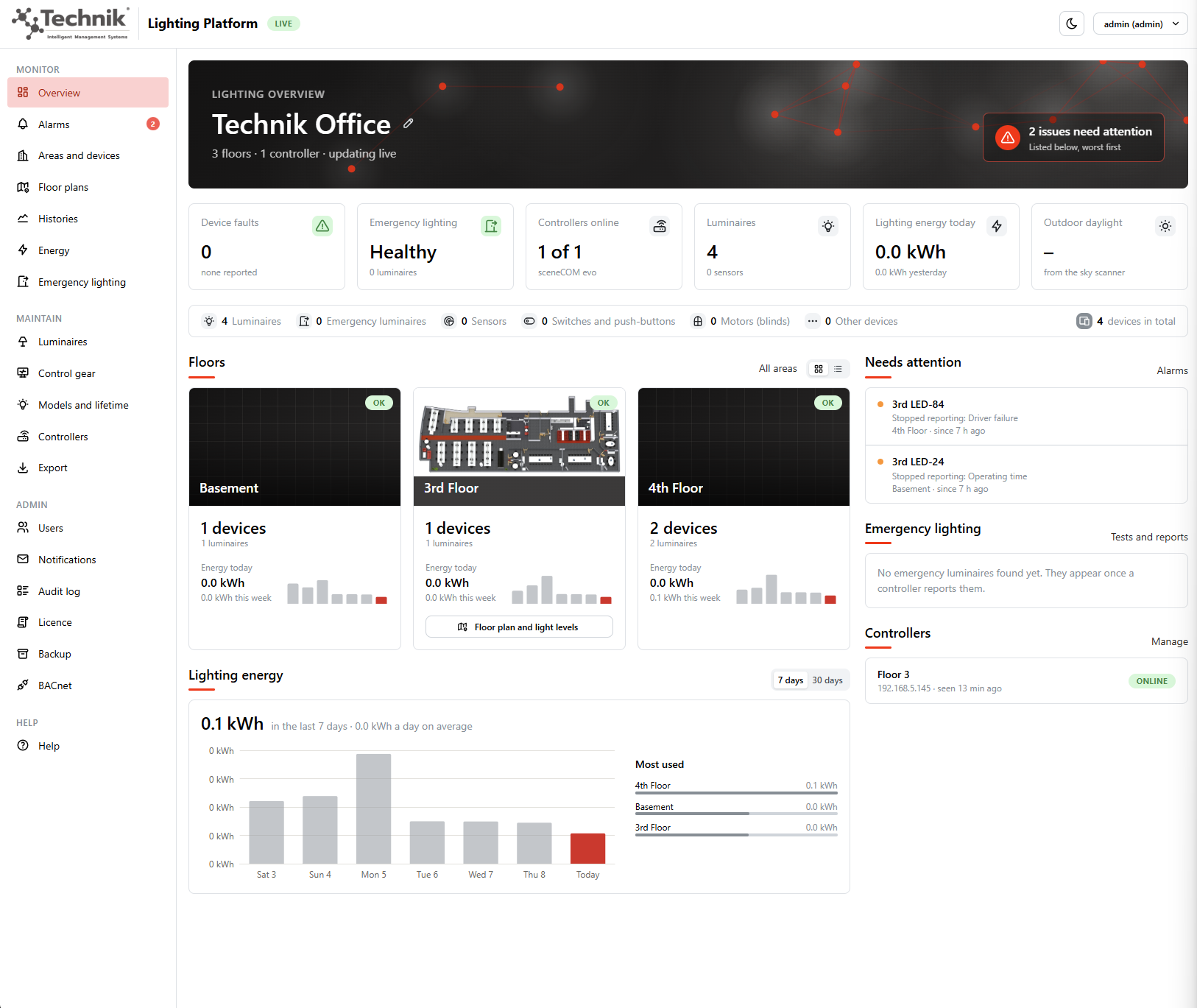
The Technik Lighting Platform connects to your Tridonic sceneCOM evo controllers over DALI-2 and turns the installation into live data: every driver identified, every fault named, light levels on the floor plan, energy by floor, and emergency testing that reports itself.
The Technik Lighting Platform
A web platform for the lighting installation, connected live to your installed Tridonic sceneCOM evo controllers over DALI-2. It is available to clients now, and it is the same platform we run on our own estate.
We are partnered with Tridonic at installation level, providing the platform layer for their control gear. Everything the platform shows is read from the DALI line itself, so the picture reflects the installation as it is, not as it was drawn.
Device faults, controllers online, luminaire count, lighting energy today and emergency status, across every floor.
Driver failures and devices that stop reporting are raised against the specific fitting, floor and area.
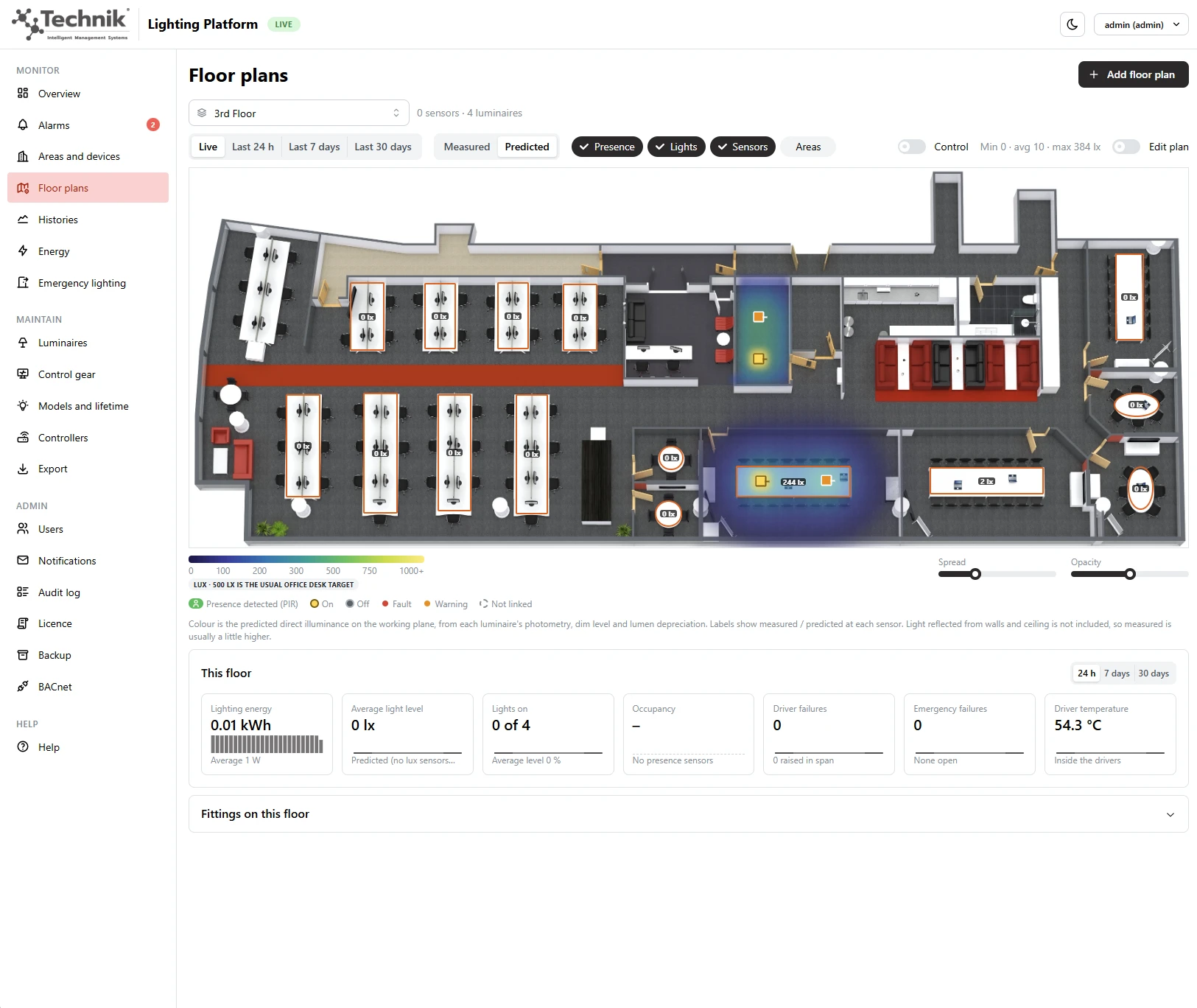
Measured and predicted illuminance on the plan, with presence, faults and unlinked fittings shown in place.
Lighting energy per day, floor and area over 7 or 30 days, with the heaviest users ranked.
Automated function and duration testing, with results and reports held against each emergency luminaire.
Multiple users with roles, a full audit log, notifications, backup, and BACnet for the wider building system.
Floor plans that show the light, not just the fittings
Each plan shows predicted illuminance on the working plane, calculated from every luminaire's photometry, its current dim level and lumen depreciation. Where lux sensors are fitted, the measured value is shown next to the prediction.
- Predicted and measured lux side by side, against the 500 lx office desk target
- Presence shown on the plan as it is detected
- Faults, warnings and unlinked fittings visible in their real positions
- Per floor: lighting energy, average light level, lights on, driver failures and driver temperature
- Live, or replayed over the last 24 hours, 7 days or 30 days
Built onto the installation you already have
We are a platform partner, not a lighting contractor. The controllers, drivers and control gear are installed by the lighting contractor or by Tridonic, and the platform connects to them over the DALI-2 lines already in place. Nothing needs re-addressing, re-commissioning or replacing.
We work with Tridonic at installation level, providing the platform layer for their controllers, drivers and control gear.
The platform talks to installed sceneCOM and sceneCOM evo controllers over the existing DALI-2 lines.
Devices, groups and areas are read as they were commissioned, so the platform matches the system you already run.
A layer added to lighting that is already working, not a reason to change it.
Lighting data exposed over BACnet, so the BMS and building front end can use it.
Occupancy and daylight, made visible
Lighting is one of the easiest loads to reduce without affecting the people using the building, but only if you can see what the sensors are actually doing.
Where occupancy and daylight sensors are fitted, the platform shows their effect: which zones are held on, which are dimming back, and what that costs. A control strategy set at commissioning becomes something that can be reviewed against real use.
- Presence on the floor plan, in the position it was reported
- Dim level and active scene per luminaire, live and over time
- Zones sitting at full output when the space is empty
- Energy by floor and area, so the effect of a setting change is measurable
- History over 24 hours, 7 days or 30 days to review against occupancy
Every driver identified, every replacement planned
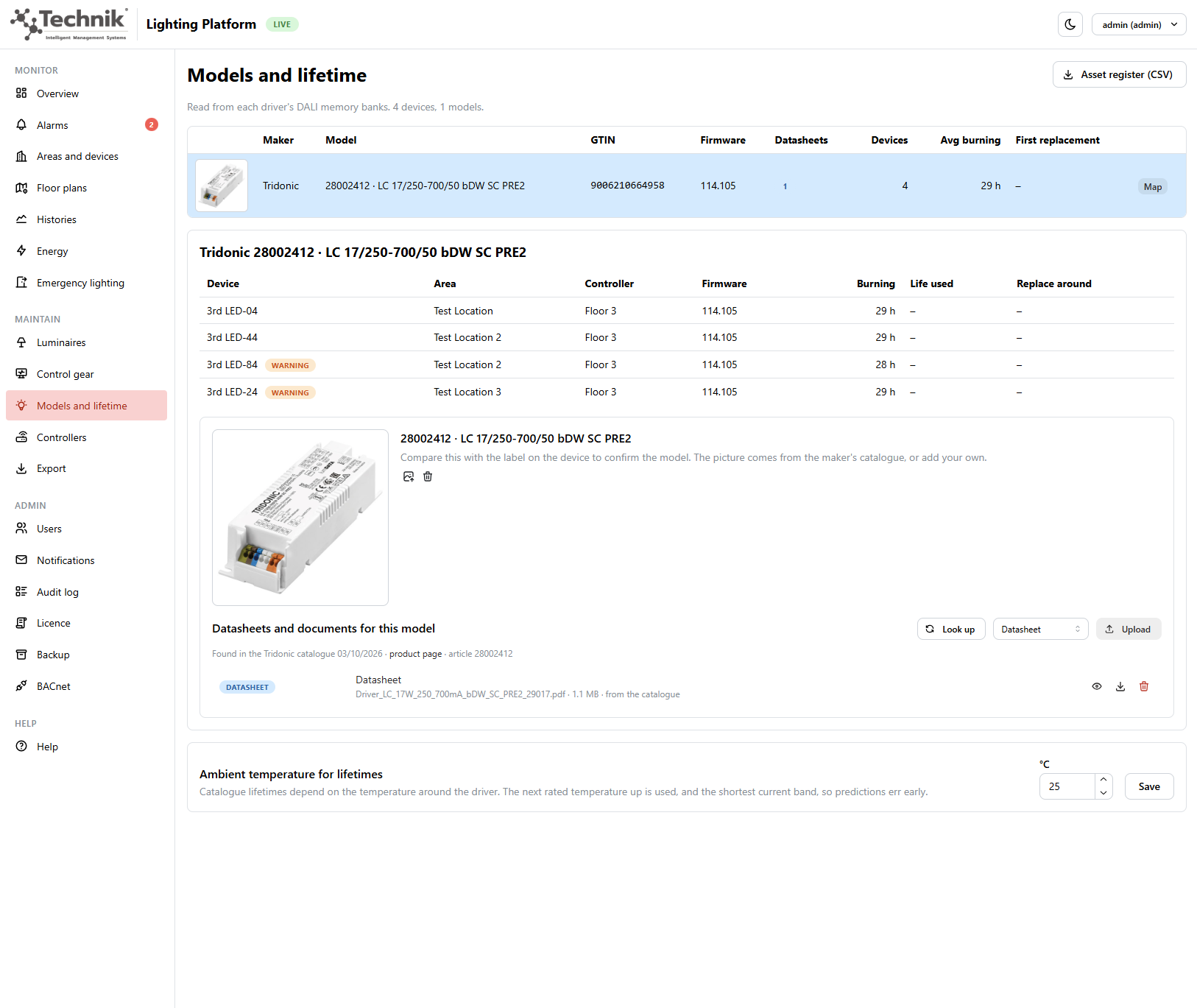
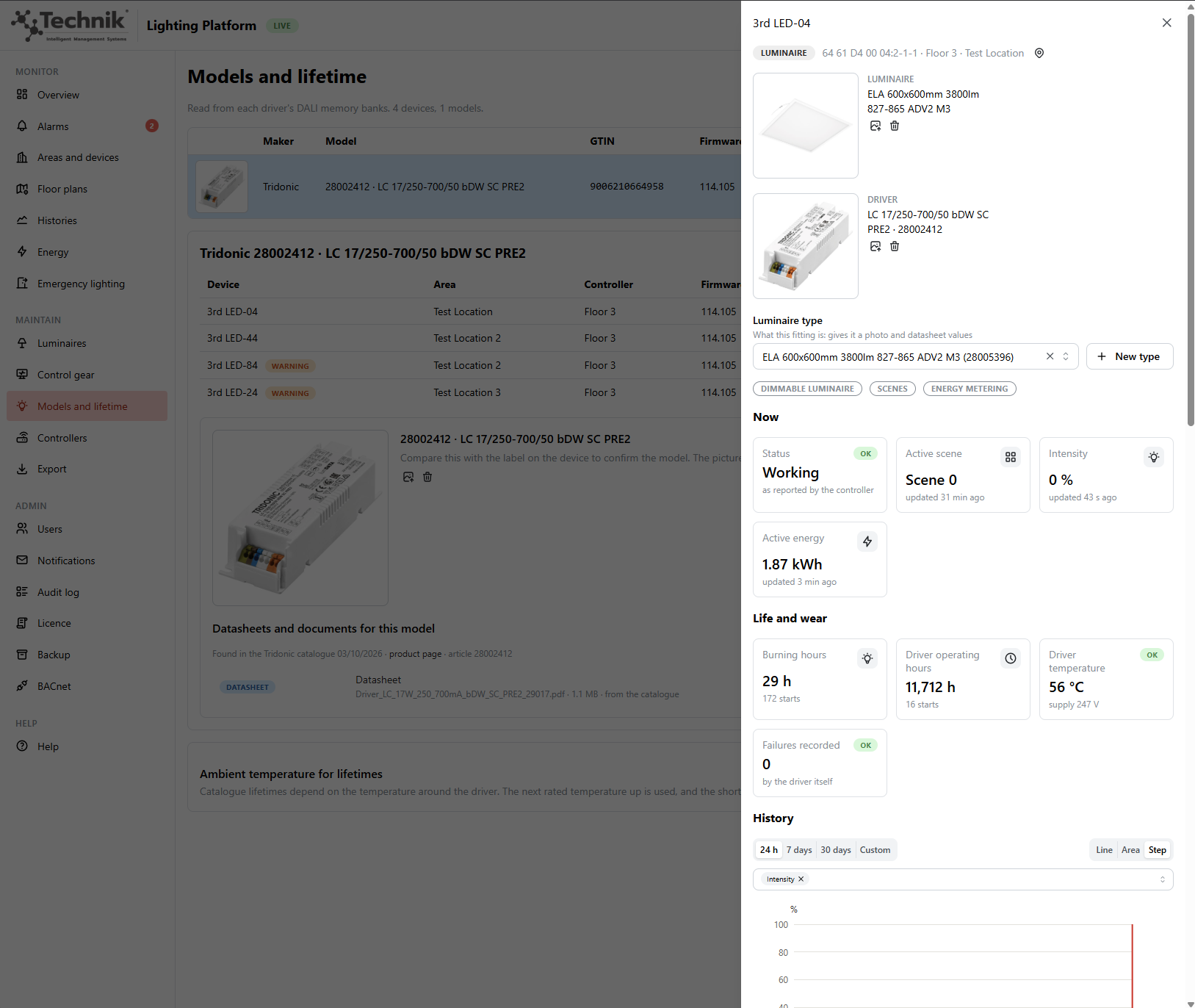
The platform reads each driver's DALI memory banks and identifies exactly what is installed, down to the maker, model, GTIN and firmware. It then matches that against the Tridonic catalogue and pulls in the datasheet and product photo automatically.
From there it tracks wear and plans replacement:
- Burning hours, driver operating hours and starts, for every luminaire
- Driver temperature and supply voltage, read from the device itself
- Failures recorded by the driver, surfaced as alarms against the fitting
- Catalogue lifetimes applied against your ambient temperature to estimate life used
- A first-replacement estimate per model, so budgets are planned rather than reactive
- Asset register export to CSV for handover, O&M files and procurement
There is no manual asset schedule to maintain, because the installation reports what it is.
Automated emergency lighting testing
DALI emergency gear can test itself and report the result. The platform schedules the function and duration tests, collects the results from the gear, and holds them against each emergency luminaire rather than on a clipboard.
- Scheduled function and duration tests run automatically across the installation
- Pass and fail results recorded per luminaire, with faults identified by address
- Battery and lamp faults surfaced when they happen, not at the next manual inspection
- Exportable logs to evidence compliance with BS 5266
- Tests staggered by area, so cover is never lost across the whole building at once
Results can be reported alongside the rest of the site data, so emergency lighting is not kept as a separate paper trail.
See it running on your estate
We will walk you through the platform on live data and scope what it takes to connect your lighting.
Get in touch